What Actually Changes When a Commercial Property Moves to Central Control Irrigation
For a property manager running dozens of zones across a multi-acre site, the shift from standalone clocks to a networked system changes not simply the equipment.
September 1, 2026 · 4 min read
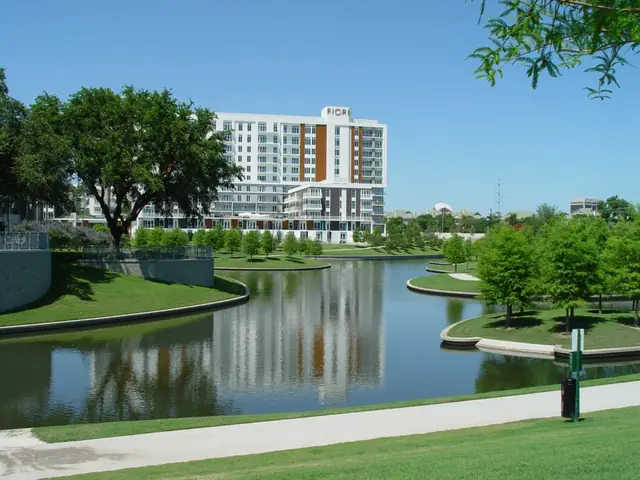
On a single-family lot, an irrigation controller is a box on the garage wall that somebody sets once and mostly forgets. On a commercial property spanning several acres, a shopping center, a school campus, or a master-planned community's common areas, that same logic breaks down fast. A site like that might have anywhere from a dozen to several dozen irrigation zones spread across parking islands, entry monuments, detention ponds, and turf panels, each one on its own standalone controller with its own schedule, its own battery backup, and its own blind spot.
The problem standalone controllers create at scale
Standalone controllers do not talk to each other. If a lateral line breaks behind a retaining wall at three in the morning, the zone keeps running on schedule until someone happens to notice water pooling across a sidewalk, or until the water bill lands and nobody can explain the spike. Multiply that across twenty or thirty independent boxes on a property with a lean maintenance staff, and the real cost of decentralized control is not the occasional wasted gallon. It is the lag between a failure happening and anyone finding out.
What central control actually changes
A central control system puts every zone on one platform, whether that is a dedicated field controller talking to a cloud dashboard or a two-wire system replacing a tangle of individual wiring runs. Scheduling moves from a technician programming each box by hand to a single interface that can adjust run times site-wide based on a weather feed, cut water to a zone the moment a flow sensor reads outside its expected range, and hand a property manager a log of exactly what ran, when, and for how long.
- One schedule change updates every affected zone instead of requiring a site visit to each controller
- Flow monitoring flags a broken head or a blown lateral within minutes instead of days
- Water use by zone becomes visible enough to catch a leak before it shows up on the utility bill
- Remote access means a hard freeze or a watering restriction can be handled from a phone, not a drive across the metroplex
Where the labor actually gets saved
The obvious argument for central control is water savings, and on a large site that argument holds up. But the bigger shift for most property managers is labor. A maintenance crew that used to spend a morning driving between controller boxes after every schedule change or every irrigation-related complaint gets that time back. On a property with irrigation spread across several buildings, phased development, or common areas managed by more than one association, that time adds up fast, and it is time a crew can spend on the things a controller cannot fix on its own, like a head that needs adjusting or a valve that needs replacing in the ground.
Licensing matters more, not less, once the system gets this complex
A networked irrigation system does not remove the need for a licensed irrigator on the account, it raises the stakes on having one. Backflow testing, cross-connection control, and the design decisions behind zone grouping and pressure management are still governed by the same state licensing structure they always were, through the Texas Commission on Environmental Quality. American Landscape Systems keeps four licensed irrigators on staff, including Vice President Joseph T. Angelone, whose license, number 6959, is the longest-held on the team, dating back to 1998. That matters most on the exact kind of property where central control gets installed: a large commercial or municipal site where a design mistake does not stay contained to one bed, it shows up across the whole irrigation zone.
What happens after hours
The other place decentralized systems fail a property is after five in the evening. A blown main on a Friday night at a retail center or an HOA common area cannot wait until Monday morning, and a standalone controller has no way to shut itself down or flag the problem to anyone. That is the specific gap a twenty-four hour emergency irrigation line closes, and it is why American Landscape Systems runs one as a separate, dedicated number, 214-801-2040, apart from the main office line. A central control platform can catch a flow anomaly automatically, but somebody still has to be reachable to act on it before a Saturday becomes a flooded parking lot.
What to ask before committing budget to a switch
A property considering the move from standalone to central control is really asking a design question as much as an equipment question: how many zones, how are they grouped, what backhaul method fits the site, and who is responsible for the licensing and the backflow testing once it is installed. Those are the questions worth putting to a contractor before signing anything, and the answers should come from someone who has run irrigation design and installation on properties at this scale, not just sold the hardware.
American Landscape Systems — (469) 521-2200
Call (469) 521-2200More articles
Specifying Turf and Planting That Actually Survives a North Texas Summer
Site conditions in the Dallas-Fort Worth area do more damage to new landscaping than the heat ever gets credit for.
What a Property Manager Should Expect From a Commercial Grounds Maintenance Contract
The gap between what a maintenance contract says and what a property actually needs usually shows up months after the ink is dry.