Specifying Turf and Planting That Actually Survives a North Texas Summer
Site conditions in the Dallas-Fort Worth area do more damage to new landscaping than the heat ever gets credit for.
September 1, 2026 · 3 min read
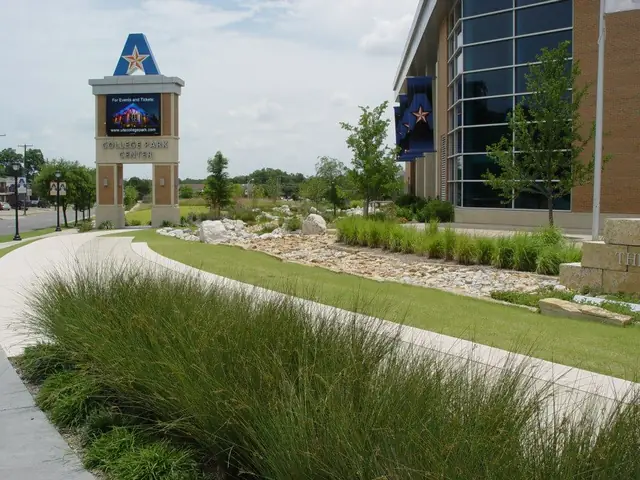
Most conversations about landscaping surviving a North Texas summer focus on heat and drought, and both matter. But on the commercial sites we work across the metroplex, the bigger threat to newly installed turf and planting is usually underfoot, not overhead. Much of the Dallas-Fort Worth area sits on blackland clay, a soil type that shrinks hard when it dries and swells hard when it wets, cracking open in August and closing back up after the first real rain. Plant material that would establish without issue in sandier soil further west can struggle here for reasons that have nothing to do with the thermometer.
What blackland clay actually does to a root zone
The shrink-swell cycle moves more than the surface. It can shear young roots that have not spread far enough to hold, heave curbs and hardscape edges out of line, and create a soil structure so dense that water either sheets off the surface or sits without draining, depending on the week. A planting plan that does not account for this, amending the bed, grading for positive drainage away from the root ball, choosing species that tolerate a heavy clay profile, is setting new material up to fail before the first summer even arrives.
Turf establishment is a window, not a date on a calendar
One of the more common mistakes on a construction schedule is treating turf installation as a task to slot in whenever the rest of the site clears out, rather than as a horticultural window with real limits. Warm-season turf needs enough soil temperature and enough remaining growing season to root down before dormancy, and a sod panel laid too late in the fall on compacted, clay-heavy subgrade is likely to look fine at handover and thin out badly by spring. Getting the sequencing right, grading and irrigation in before turf goes down, turf down early enough to establish, matters more on this soil than on almost any other input into the final look of the site.
Drainage is a planting decision, not just a civil one
On flat commercial sites, which describes a large share of the retail centers, school campuses, and office parks across the metroplex, drainage often gets treated purely as a civil engineering problem solved with grading and pipe. But the planting design has to work with that grading, not around it. A dry creek bed, for example, can double as a functional drainage channel and a planting feature at the same time, carrying stormwater during a heavy rain event while supporting ornamental grasses and ground cover the rest of the year that tolerate both standing water and extended dry spells. Done well, it reads as a design choice. Done as an afterthought, it reads as erosion.
- Grade beds to move water away from root balls, not just away from the building
- Choose species tolerant of both heavy clay and periodic standing water on flat sites
- Match irrigation zoning to the actual drainage pattern of the bed, not a generic layout
- Sequence turf installation to the establishment window, not the construction calendar
Why this shows up most on large, phased sites
A single residential yard can absorb a planting mistake. A master-planned community's common areas, a school district's campus, or a multi-acre retail development cannot, because the same design gets repeated across dozens of beds and hundreds of linear feet of turf panel. Our estimating and design work is led in part by Aaron Jaska, whose background is a bachelor's degree in landscape architecture from Texas A&M with an emphasis in urban planning and turf management. Coming out of school and into the estimating department rather than straight into design gave him a specific vantage point: knowing what a planting plan looks like on paper and knowing what actually survives blackland clay and a Dallas-Fort Worth summer once it is in the ground are two different questions, and the gap between them is where most commercial landscape budgets get wasted.
What holds up, five and ten years out
The plant list that looks impressive on a rendering is not always the one still performing a decade later. Species selection for a commercial site in this region has to account for the clay, the heat, the occasional hard freeze, and a maintenance program that will not always catch a problem in its first week. That is a different design conversation than picking what looks best in the nursery, and it is the one worth having before anything goes in the ground.
American Landscape Systems — (469) 521-2200
Call (469) 521-2200More articles
What Actually Changes When a Commercial Property Moves to Central Control Irrigation
For a property manager running dozens of zones across a multi-acre site, the shift from standalone clocks to a networked system changes not simply the equipment.
What a Property Manager Should Expect From a Commercial Grounds Maintenance Contract
The gap between what a maintenance contract says and what a property actually needs usually shows up months after the ink is dry.